

Ademola Lookman brings the old and the new to Atlético Madrid
The Nigerian has been a plug-and-play standout in his introduction to Spanish football.

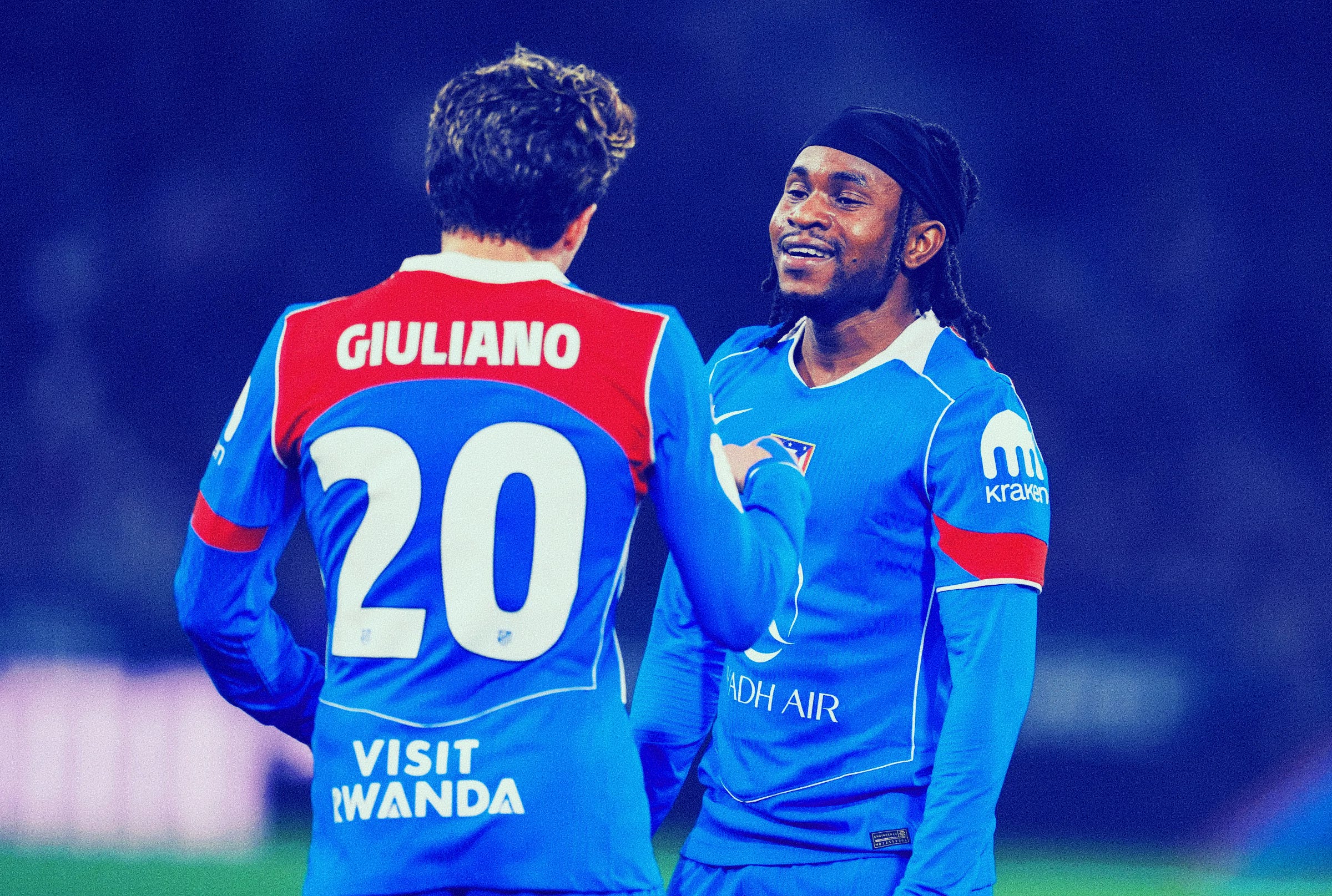
It will be some time before we can say whether Ademola Lookman was worth his signing. But in the present, where Diego Simeone’s prerogative is to be as competitive as possible as soon as possible, we can already conclude that that ceiling of competition has been prodded up by his arrival.
(Is the adaptation period in the room with us now?)
Editor’s note: A rotated Atlético side were beaten 3-0 by Rayo at the weekend, in another limp display typified by the more fringe players struggling (it was already 2-0 by the time Lookman got the final half hour). Simeone’s side have veered wildly from outstanding to dismal in recent weeks, but two of the wins by 4+ goals have been in two of Lookman’s three starts.
There will be endless interpretations of why Lookman has looked instantly impactful for Atlético, but none of them seem more adequate than the fact that he is… a very good footballer. At the welcome risk of underthink, he has been featured in his preferred areas (wide forward who drifts between the wing and left-leaning central spaces), often has an overlapping wing back on his left shoulder, and has more generous starting points in attacking transitions than the winger on the opposite side — a la Vinícius Júnior — due to Atlético’s off-ball shape in deeper areas (Thanks, Giuliano.)
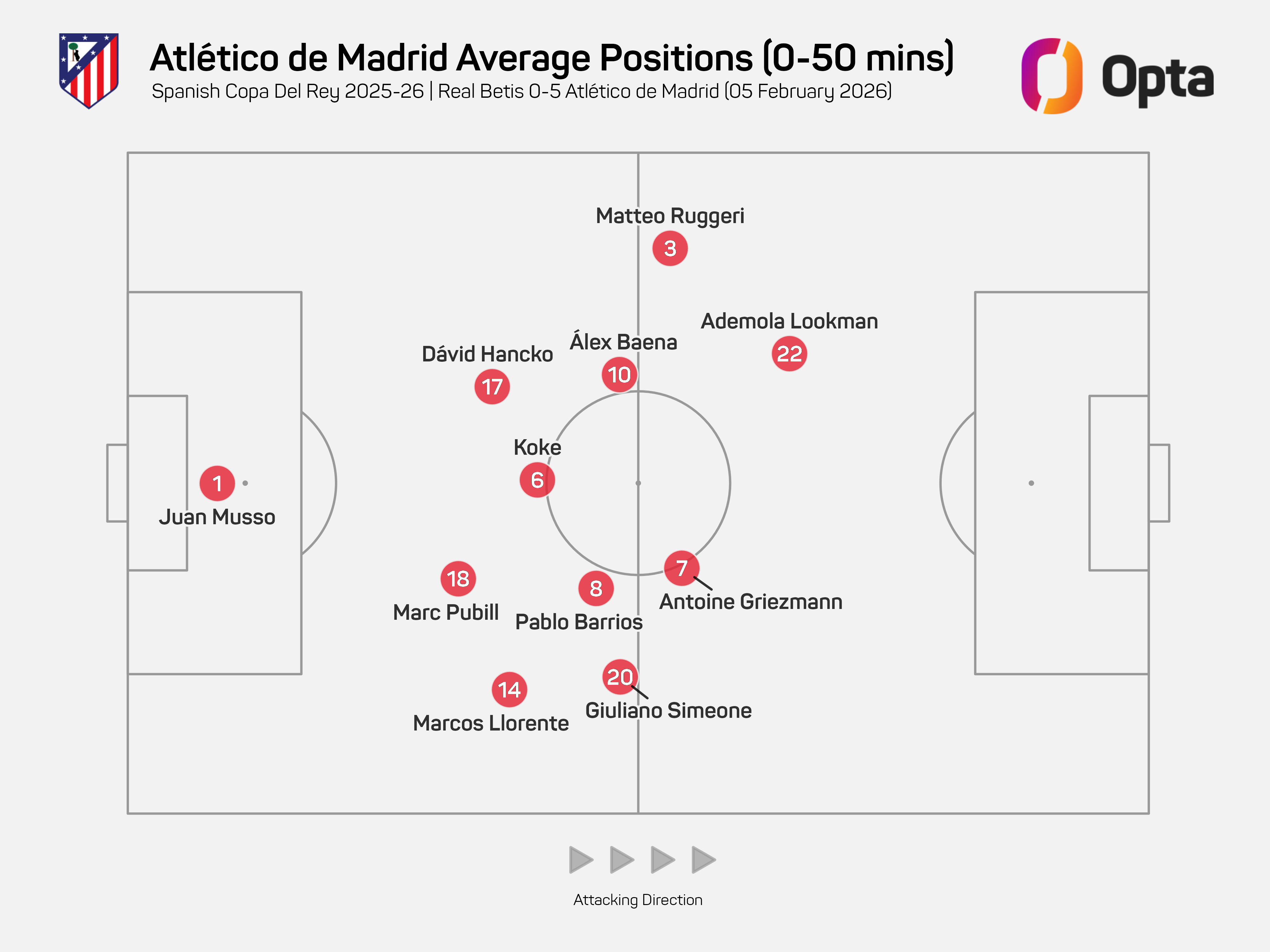
Plus, watch out if they can get the best version of Álex Baena — one of the premier through ball artists in Europe — going on that same side of the pitch, as we saw in flashes versus Betis at the start of the month.
Suffice to say, it hasn’t taken any real innovation from Simeone to engage Lookman because it just hasn’t been required. No stylistic, non-tinkering shame in that. “He’s a big boy, already 28 years old…” said Simeone after his debut. “He has different [attributes] to the players we have and he will make us better.”
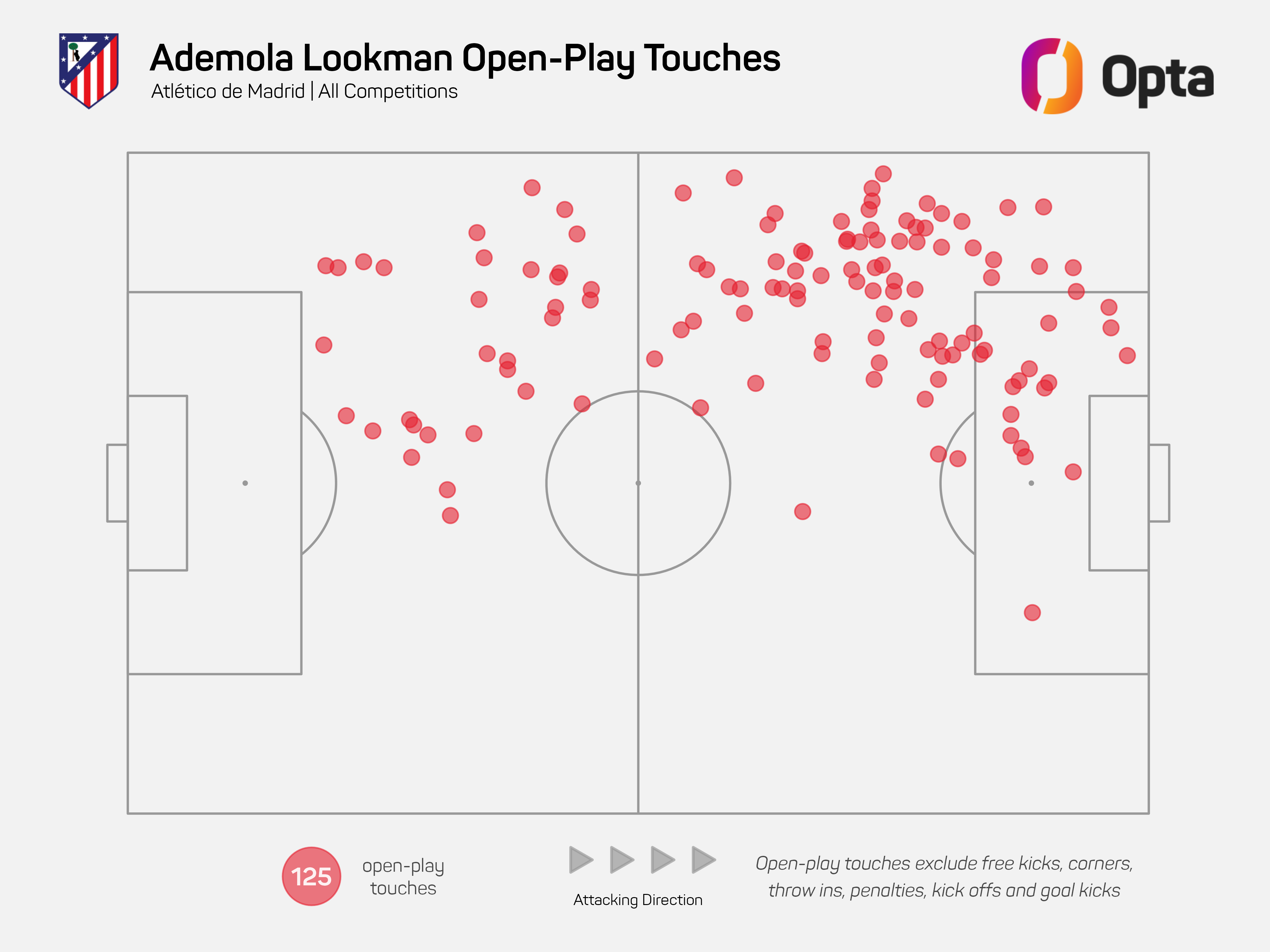
Lookman has scored and assisted in two of his first three starts for Atlético. No LaLiga player across has done so more than twice in 2026 — and, of course, Lookman didn’t debut for them until February 5th.
Unsurprisingly, all four of those have been notched in the course of quick, direct attacks. The first came from a sharp transition from deep in his own half at Betis, the second an assist on a two-man attack with Griezmann, the third a late arrival to finish at the back post, and the fourth a tidy lay-off against a Barcelona side scrambling back towards their box and leaving the edge open.
Lookman is a sure thing in transition and whenever he has big spaces to attack. We knew that before he arrived in Madrid. He can carry the ball long distances at speed, he’s quick, shoots well off both feet, and he moves under control with an appreciation for developing attacks. His assist for Antoine Griezmann on his debut was a prime example of his sophistication when handing the latter; the way he throws in his stepovers as if to convince the defender he’s in dribble and shoot mode, after having slowed enough to bring Griezmann’s run into play (and probably known all along that’s where he was heading).
The early goal production speaks for itself. But from his first half of football in an Atlético shirt, Lookman’s impact on general play has been about as coherent as Simeone could have hoped for. And crucially, coherent without being predictable.
Though known primarily as a dangerous ball carrier, he has proved sharp in making runs beyond the defence (out to in, in these cases):
And when not running in behind… note his patience here to hold off going beyond the last line, knowing a pass to feet will bring Álvarez into play:
Lookman has created varied advantages for the team with and without the ball, connected well with teammates, and displayed a good balance between the more individual pursuits a winger must undertake with knowing when to keep the ball moving. In a team where the existing wingers were liable to be dynamic to a fault — a little too hasty to accelerate at every opportunity — the Nigerian’s measured style of dribbling has been especially felt in this new context.
Indeed, when Simeone described him as a “one-v-one specialist” after his debut, he likely wasn’t just talking about dribbling past defenders.
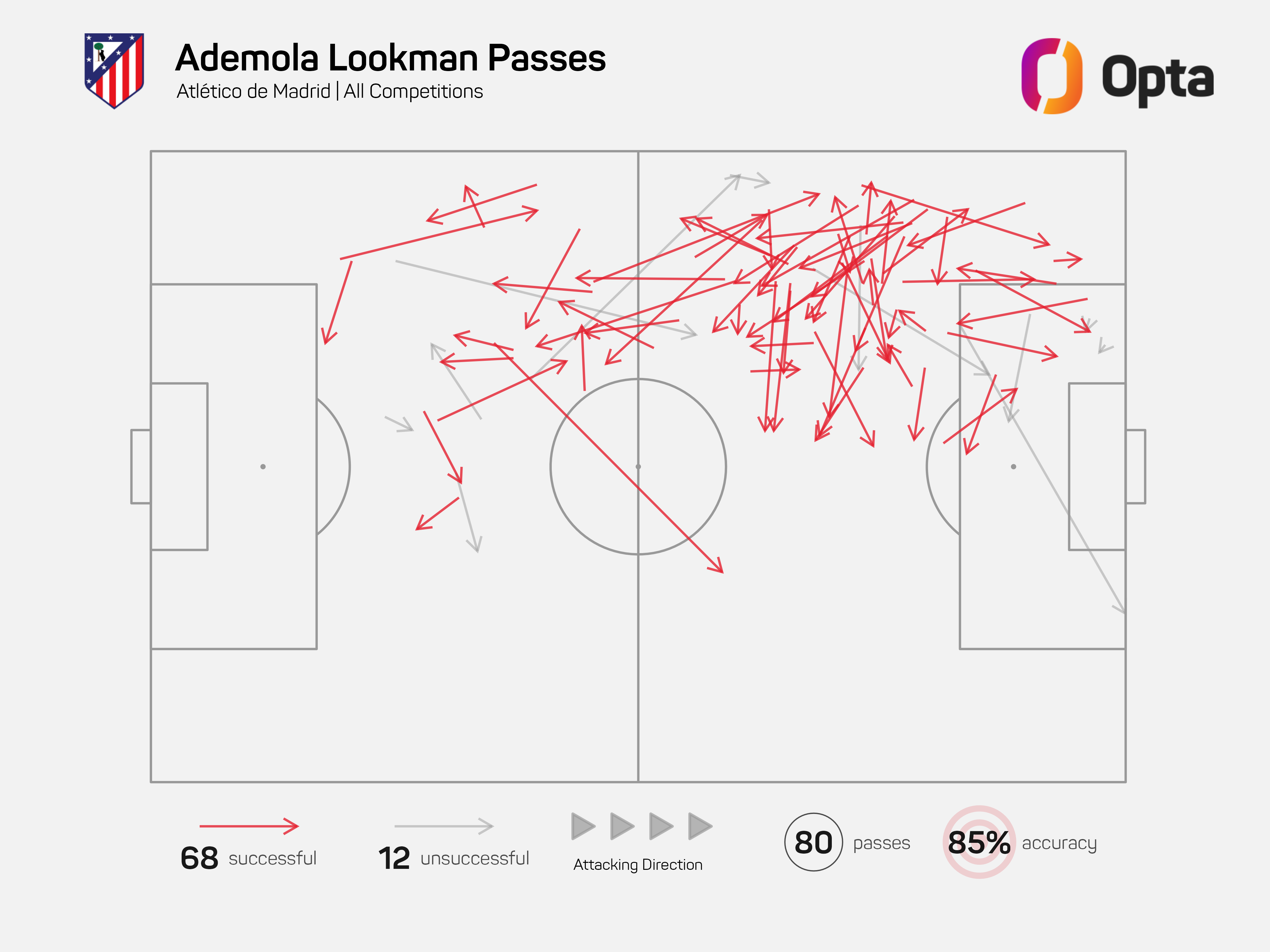
Longer term followers of Atlético and Spanish football will remember the best days of Yannick Carrasco — a natural wide player who became a wing back of sorts, who was a bit of a maverick, and someone who will have tested Simeone’s patience at times. But what he had was an ability to threaten as a ball carrier and bring his team along with him; that regulated style of dribbling which allows teammates to provide support and take up complimentary positions, and the necessary slowing down in the final third that helps precision of attack. He was quick when it was eventually time to go, but deliberately slow beforehand. Lookman has that too.
It helps that the Nigerian has been one of the biggest ball-carrying goal threats in Europe across recent seasons.
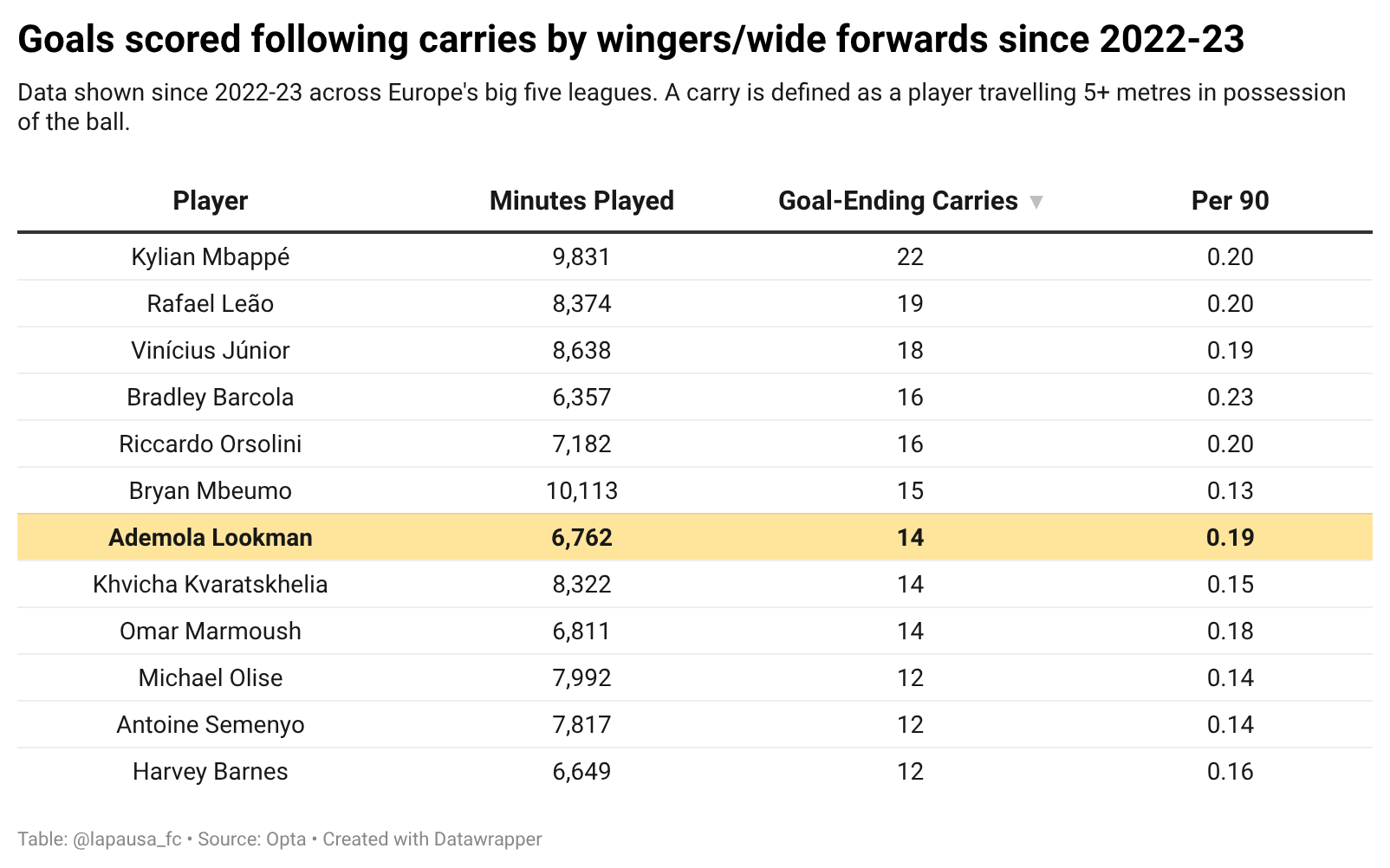
Or rather, it is a fundamental part in his variety of dribbling. Opponents fear losing a step one-v-one and giving up space to shoot or find a teammate, and Lookman willingly accepts any reticence to engage, walking them down or freezing them into that initial doubt. When you have that ability to beat defenders in a variety of ways — be it through acceleration or trickery — slowing down in those initial stages becomes a weapon at the team level, allowing players to position themselves for crosses and more time to recruit numbers.
In the below example, note the differing scenes in the penalty area from when Lookman first gets on the ball and by the time he makes his cross. Where an early delivery would have found a crowded box, his longer dribble gives his teammates an eternity to decide and time their movements, making for a harder cover for the defensive side. And when Lookman finally crosses, those runs into the six-yard box open up plenty of space (relative to penalty area space) for a player moving the other way.
As opposed to Atlético’s right side, where more of their play relies on speed of runs and repeatable give-and-goes, Lookman’s arrival on the other side improves their ability to attack without the need for speed. When he drifts out to the left side, that backing down style of dribbling — plus his ability to beat his man — ought to allow them to be more effective when feeding passes or crosses into the penalty area. Giuliano Simeone, of course, needs no invite to attack the back post from the right.
Atlético, too, are a team who like to attack the box with numbers to try and finish off much of their wide play.
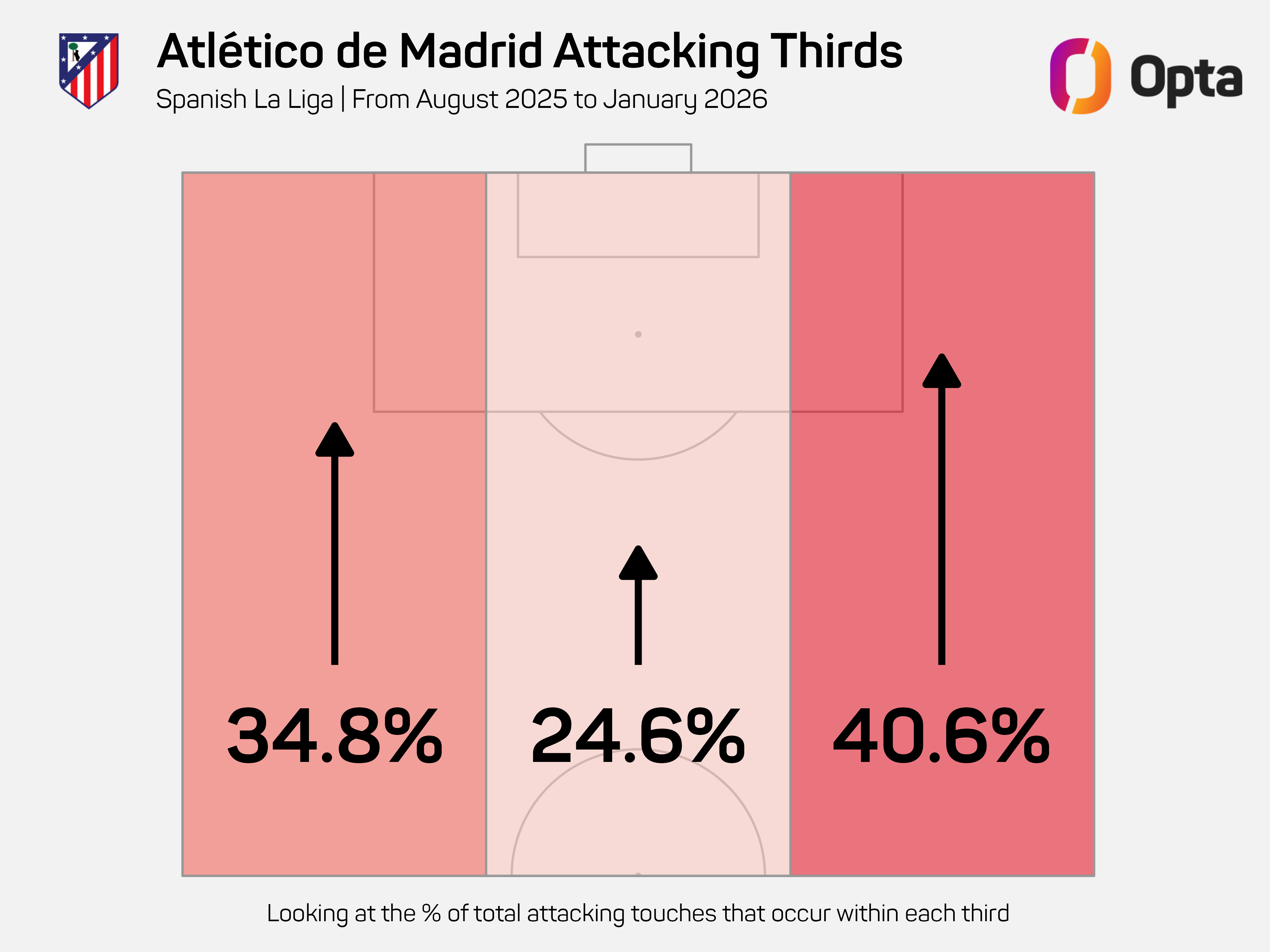
Up to now, they have been one of the most right side-heavy teams in LaLiga this season, with 41 percent of their touches in the attacking half happening there up until the start of this month. Lookman’s threat from left-leaning positions should help them alter that balance; although, the alternative of leaving more space for him to isolate wide on the left would be no small consolation too.
The best versions of Simeone’s team this season have tended to happen in games where they’ve attacked at speed and played at a high tempo. While rarely dominating the ball, they are active when it comes to attacking the opponent’s back line, as evidenced by the fact that only PSG (69) have made more defensive line-breaking passes than Atlético (67) in the Champions League this season.
Ademola Lookman has plenty of use in that style, especially when Atlético can launch fast attacks from deeper areas (see their recent Copa del Rey games). But he’s also a wide forward who can work openings off the dribble without the permanent need to be successful with his first off-ball run or dribble attempt, usually when there’s immediate space to work with. Slowing down or figuring an alternate way to break the opponent down — or merely make the right decision to give the ball up and keep the play moving — is something they struggle with on the opposite flank if they can’t punch through in behind early in moves.
As Simeone’s side search for more variety of attack in games missing those speed-optimised conditions, the Nigerian’s ability to be productive at different tempos and make the opposition think more should become a necessary solution.
Whether he’s a starting left winger or a left-leaning striker, Atlético will need his craft with the ball in coming months — and especially that flicker of Carrasco.